In June 2026, the news broke that David Hockney, one of the great figures of contemporary art, had passed away. He was 88. His large round glasses, the cigarette often in his hand, and the cheerful way he spoke in interviews had become part of his unmistakable presence. Whenever I saw him on television or in magazines, there was something warm and magnetic about him.
The first time I felt strongly drawn to Hockney’s work was when I was studying in Chicago and stood in front of American Collectors (Fred and Marcia Weisman)at the Art Institute of Chicago. It showed the light of Los Angeles, a carefully arranged garden, sculptures, and two figures standing within that space. But it was not simply a “bright” painting. The distance between the two people, their strange relationship to the sculptures and the architecture, and something unspoken beneath the surface seemed to emerge more and more the longer I looked at it. The painting did not explain anything directly, yet each time I saw it, it moved something in me. I think that is part of the mysterious power of Hockney’s work.
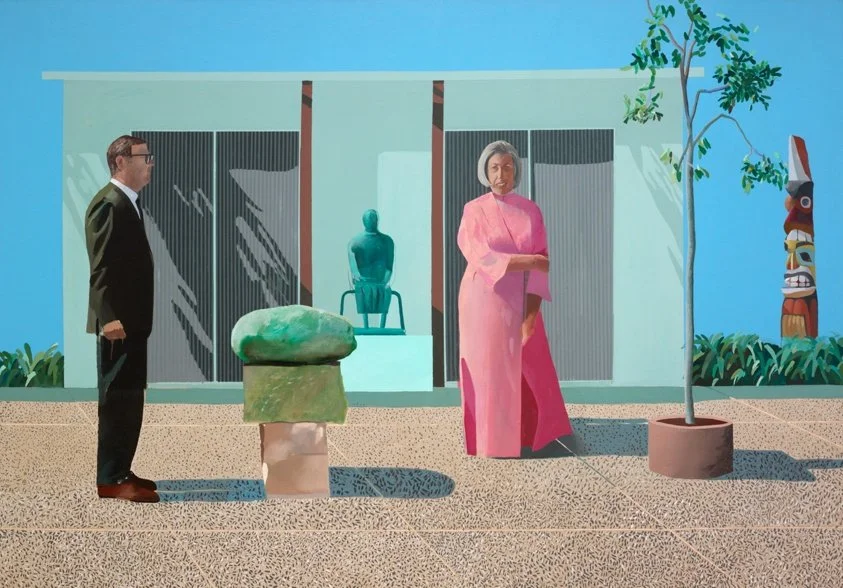
David Hockney, American Collectors (Fred and Marcia Weisman), 1968.
Acrylic on canvas. The Art Institute of Chicago.
© David Hockney.
Image included for reference in connection with the discussion of the work.
Image source: The Art Institute of Chicago.
URL: https://www.artic.edu/artworks/102234/american-collectors-fred-and-marcia-weisman
In his later years, Hockney surprised the world with his iPad drawings. The vivid landscapes created on a touchscreen easily overturned the assumption that digital works were somehow inferior. He accepted new tools naturally, almost as extensions of the paintbrush, and explored their possibilities with remarkable curiosity. In interviews, he sometimes spoke as if he was aware that death was not far away. Even so, he never seemed to lose his desire to keep making work. That determination to live fully as an artist until the end will remain in the minds of many people.
This may be a slight digression, but Hockney’s death was covered in Japan mainly by art-related media. It rarely became a major headline in general newspapers or television news. By contrast, when a bear attack occurs in a rural area, for example, the same story may be repeated again and again as a top news item. I am not saying that such incidents should not be reported. Still, I cannot help feeling a little saddened by the fact that the death of such a major artist was treated so quietly. Perhaps this reflects one of the problems in Japan’s media environment: art and culture are still often pushed aside as things that are not directly connected to daily life.
There is brightness in Hockney’s work. But that brightness is not simple. Behind it, there remains a sense of distance between people, a stillness of space, and emotions that cannot easily be put into words.
I feel sad that Hockney is gone. But his works will continue to remain in front of many people for a long time. I, too, hope to remember the strange feeling I had when I stood before American Collectors.